Proceedings of the Square Moon Society · Notes
Ramanujan’s Squaring of the Circle and the Lunar Circlefication Constant
In 1913 Srinivasa Ramanujan published a one-page note in the Journal of the Indian Mathematical Society called “Squaring the circle”. It contains a construction and a number, and the Society holds that they are the same object seen twice.
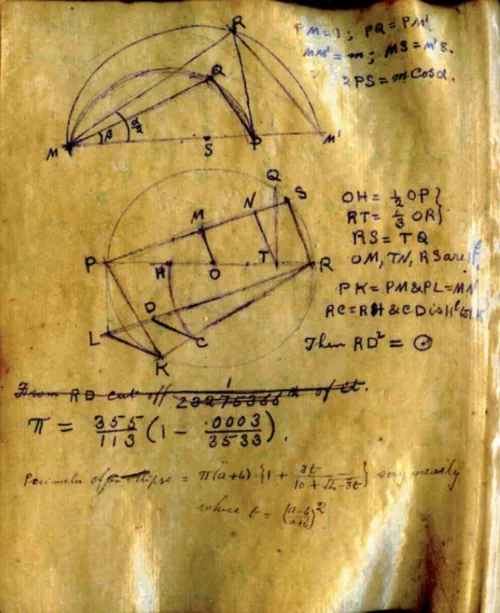
The construction
Ramanujan’s construction starts from a circle with centre O and a diameter PR. With OH = ½OP, RT = ⅓OR and RS = TQ, a short chain of further steps yields a segment RD such that RD² is—very nearly—the area of the circle. The construction is exact in every one of its algebraic steps. It is approximate only because, as Lindemann showed in 1882, every ruler-and-compass quadrature must be: the side of the true equal-area square is r√π, and √π is not constructible (see why π can never be solved).
The two numbers
Alongside the construction, Ramanujan’s notebook gives the approximation
π ≈ (355/113) · (1 − 0.0003/3533),
and his 1914 paper Modular equations and approximations to π gives the remarkable
π ≈ (9² + 19²/22)1/4 = (2143/22)1/4 = 3.141592652582…
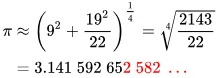
The first is correct to fifteen decimal places, the second to nine. Both are algebraic: one is rational, the other the fourth root of a rational. Neither is π, and neither could be.
A correction in the margin
The factor (1 − 0.0003/3533) is a correction to the famous fraction 355/113 of Zu Chongzhi (fifth century), of relative size 8.5 × 10⁻⁸. In the paper’s framework, where every error δ in π corresponds to a residual corner angle ε ≈ δ/2π on the circlefied square, this one marginal correction moves the residual from 4.2 × 10⁻⁸ radians to 2.1 × 10⁻¹⁶ radians: a gain of eight orders of magnitude from a factor Ramanujan wrote in the margin.
The Lunar Circlefication Constant
That a rational and a quartic approximation, arrived at independently, both stall against the same transcendental wall is, the authors submit, not a coincidence of arithmetic but the detection of a physical constant. The quartic residual is named the Lunar Circlefication Constant:
επ ≡ 1.60 × 10⁻¹⁰ rad,
the largest residual corner angle compatible with degree-four circlefication. The rational value 2.1 × 10⁻¹⁶ rad is its floor: the smallest corner that can survive any circlefication expressible in closed rational form. At the mean Earth–Moon distance of 384 400 km, επ corresponds to a corner protrusion at the lunar limb of about six centimetres—below any telescope’s resolution, above the millimetre precision of lunar laser ranging.
The ellipse formula and libration
The same notebook page carries Ramanujan’s celebrated approximation for the perimeter of an ellipse with semi-axes a and b:
P ≈ π(a + b) · (1 + 3t / (10 + √(4 − 3t))), t = ((a − b)/(a + b))².
The paper uses it for the libration correction. The lunar cube rocks by up to 6.9° against the line of sight, so its Earth-facing face is seen slightly foreshortened and its circlefied image is not a circle but an ellipse. Ramanujan’s formula gives the perimeter deficit of that ellipse as 0.362 %; the perimeter deficit of the foreshortened square, ½(1 + cos β), is also 0.362 %. The two agree to five significant figures. To first order a square and its circlefication foreshorten identically—which is precisely why libration has never betrayed the corners.
Why Ramanujan is the crucial link
Between the ancient constructions of Hippocrates and Archimedes and the modern decompositions of Tarski and Laczkovich, Ramanujan is the one mathematician who did both things at once: drew the figure and named the number. That is why the paper places his page at the centre of its argument and calls his two approximations the third and fourth stages of circlefication.